The Architecture of Tension:
A Unified Stance
For more than six decades, my work has moved across fields that casual observers might view as entirely distinct: public governance, trade union education, musical structure, the physical landscape, and the literary essay.
To the modern eye, which prefers strict specialization, moving between these domains looks like flitting from one interest to another.
The reality is entirely different. I have spent 62 years practicing a single, unified methodology: using the essay as a mode of inquiry to study how complex systems navigate structural tension.
Whether looking at a legal framework, a musical score, or a mountain trail, I am always looking at the exact same thing: how form handles friction.
The Four Quadrants of a Single Mind
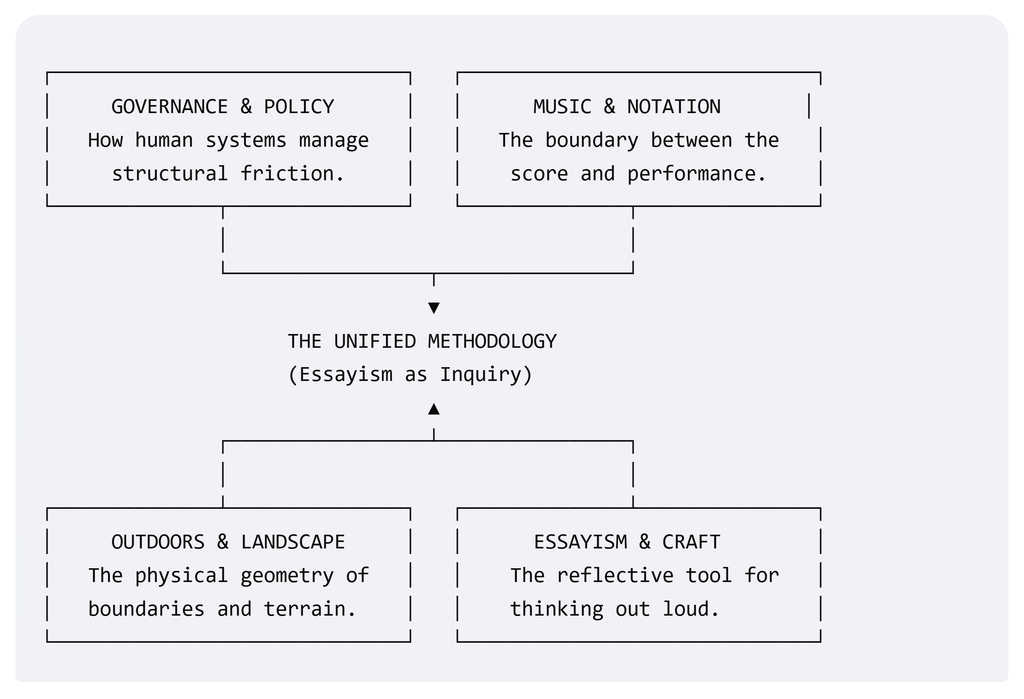
Every surface I write upon, across my distributed network of publications, explores this same core inquiry through a different lens.
1. Governance & Public Policy
In public policy, tension exists between the rigid geometry of regulation and the chaotic, fluid movement of human behavior. My work in this space is an investigation into how institutions hold together under pressure, where legal frameworks fracture, and how systems can be designed to absorb friction rather than break.
2. Music & Notation
Music is the ultimate study of controlled tension and release. I am fascinated by the boundary where strict notation ends and human interpretation begins; the friction between the silent, structural code of the score and the living reality of the performance.
3. The Outdoors & Landscape
Walking a landscape is not a passive pastime; it is a kinetic engagement with natural boundaries, topography, and physical resistance. A trail is a historic record of human navigation negotiating the friction of the earth’s geometry. My writing on the outdoors applies the exact same structural analysis to a mountain ridge that I apply to a legislative policy.
4. Essayism as the Central Anchor
Connecting all of this is the essay form. Following the tradition of Montaigne, I view the essay not as a polished lecture or an adversarial newspaper op-ed, but as a dynamic “testing ground.” It is the architectural space where I step back, hold disparate tensions in place, and allow their underlying structures to reveal themselves over time.
A Commitment to the Slow Web
Because this methodology requires unhurried reflection, my writing is intentionally decentralized. I deliberately resist the immediate demands of modern internet algorithms and commercial print sales. Meaning accumulates slowly, or it does not accumulate at all.
You are invited to explore this inquiry across my specific writing surfaces:
- Governance & Public Policy: Read Marshall on Policy, Brief Me, and my other policy-focused briefings.
- Essayism & Craft: Explore the core philosophy at Essayism, which serves as a gateway to my various working spaces—including The Essayists Notebook, The Essayist, reflections on the craft, and my finished Essays.
- Landscape & Terrain: Follow my long-term tracking of physical paths at Best Walks in Ireland.
- Music & Structure: Read about harmonic frameworks through My Guitar Project and active essay series like The Story of Music.